

The Melbourne sun was relentless, the air heavy, and the temperature creeping towards 40 degrees Celsius. For 24-year-old Jannik Sinner, the two-time defending Australian Open champion, it was shaping up to be the kind of afternoon that ends title dreams early. His movement slowed, cramps spread through his legs and arms, and across the net stood 24-year-old Eliot Spizzirri, the world No. 85, swinging freely and sensing history.
Yet by the end of four sets, it was Sinner walking off Rod Laver Arena as the victor, having turned a moment of near collapse into one of the most unlikely escapes of his Grand Slam career. The turning point came not from a forehand winner or a clutch serve, but from the Australian Open’s heat rule — a regulation designed to protect players, and one that Sinner admitted afterwards had given him a lifeline.
“I got lucky with the heat rule,” he said later, his honesty reflecting both relief and realism.
A match slipping away
The early signs were promising for the Italian. Sinner struck the ball cleanly in the opening games, dictating rallies and forcing errors from Spizzirri. But the scorching conditions quickly changed the rhythm of the match. The American, playing only his third main-draw match at a Grand Slam, grew in confidence as Sinner’s energy visibly drained.
Spizzirri claimed the first set 6–4 and continued to pressure Sinner in the second. Although the champion levelled the match with improved aggression, his body was beginning to betray him. By the opening games of the third set, Sinner was struggling to walk between points, his serve lost pace, and he fell behind a break at 3–1.
For a player who thrives on relentless baseline pressure and precise footwork, the signs were ominous. The match — and perhaps his title defence — appeared to be slipping away under Melbourne’s furnace-like conditions.
The moment that changed everything
Then, in a twist that felt scripted, the tournament’s heat stress scale reached its maximum level. Play was suspended, and the roof over Rod Laver Arena was ordered shut.
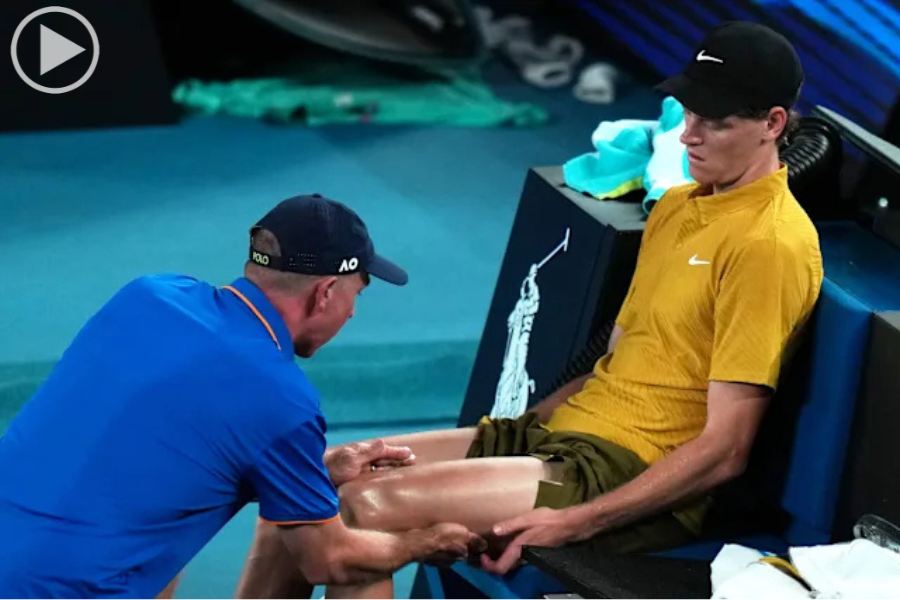
Sinner limped off court for treatment, while Spizzirri stood at the baseline shaking his head, stunned by the interruption of his momentum. The rules had been applied correctly, yet the timing was brutal for the American and perfectly aligned with Sinner’s moment of greatest need.
When play resumed, the temperature inside the arena had dropped to around 26°C, a dramatic shift from the outdoor heat. More importantly, Sinner looked reborn. Still moving cautiously, he struck the ball with renewed authority, breaking back immediately and seizing control of the set. Within minutes, the match had swung on its axis.
From survival to dominance
The cooler conditions transformed not only Sinner’s body, but his mindset. His footwork sharpened, his shot tolerance increased, and his trademark depth off both wings began to overwhelm Spizzirri. A set that had seemed destined for the American turned into a 6–4 recovery for the champion.
From there, the pattern was clear. Sinner stayed upright at many changeovers to avoid stiffness, managed his energy carefully, and relied on precise first-strike tennis rather than extended rallies. Spizzirri continued to fight, but the emotional toll of losing momentum after dominating the third set proved difficult to overcome.
Sinner closed out the fourth set 6–4, sealing a victory that looked improbable less than an hour earlier. A puffed breath and a weary smile at the net told the story: not triumph in comfort, but survival through adversity.
Melbourne’s furnace beyond the court
While the drama unfolded inside Rod Laver Arena, Melbourne Park itself was battling the heat. Matches on outside courts were suspended, and nearly 100,000 fans were urged to take precautions. Spectators moved through mist tunnels, queued at hydration stations, and sheltered under umbrellas and shaded zones.
Ball kids worked on shortened 45-minute rotations, with extended breaks between shifts, while staff handed out water to fans in long queues. The Australian Open’s infrastructure was stretched into emergency mode, turning the precinct into a survival operation as much as a sporting festival.
Without these measures — and without the roof closure — Sinner’s match might never have turned. The “furnace” of Melbourne was not just a metaphor; it was a tournament-wide reality that reshaped the day’s schedule and outcomes.
A reminder of tennis’s finest margins
The match was a vivid illustration of how tennis, especially at Grand Slam level, can pivot on moments far removed from baseline exchanges. A decimal shift on a heat stress scale changed the course of a contest, and possibly the shape of the tournament.
Sinner did not hide from that reality. “I struggled physically today. I got lucky,” he admitted. There was no attempt to romanticise the escape — just an acknowledgment that championships often require fortune as well as skill.
For Spizzirri, the defeat was painful but illuminating. At 24 years old, the American matched his peer shot for shot in brutal conditions, broke his serve repeatedly, and forced one of the world’s best players to the edge. Even in defeat, his performance marked a breakthrough moment.
A victory that may define a campaign
In scoreline terms, a 4–6, 6–3, 6–4, 6–4 win may not look extraordinary for a reigning champion. In context, however, it stands as one of Sinner’s most significant victories — not for its elegance, but for its improbability.
He did not simply outplay an opponent; he outlasted the climate, his own physical limits, and a moment when his tournament seemed over. The heat rule did not win the match for him, but it gave him the chance to win it himself — and champions, when given a second life, rarely waste it.
Sinner now advances to face fellow Italian Luciano Darderi for a place in the quarter-finals, carrying not just momentum, but proof that in Melbourne’s furnace, resilience can matter as much as brilliance.