

Alcaraz Outlasts Zverev in Five-Hour Melbourne Epic to Reach First Australian Open Final
Carlos Alcaraz delivered one of the most courageous performances of his career to defeat Alexander Zverev in a five-set marathon at Melbourne Park, sealing his first Australian Open final and keeping alive his bid to become the youngest man to complete a career Grand Slam.
The world number one triumphed 6-4, 7-6(5), 6-7(3), 6-7(4), 7-5 in five hours and 27 minutes — one of the longest matches ever played at the tournament and easily the most gripping of this year’s edition.
Commanding Start from Alcaraz
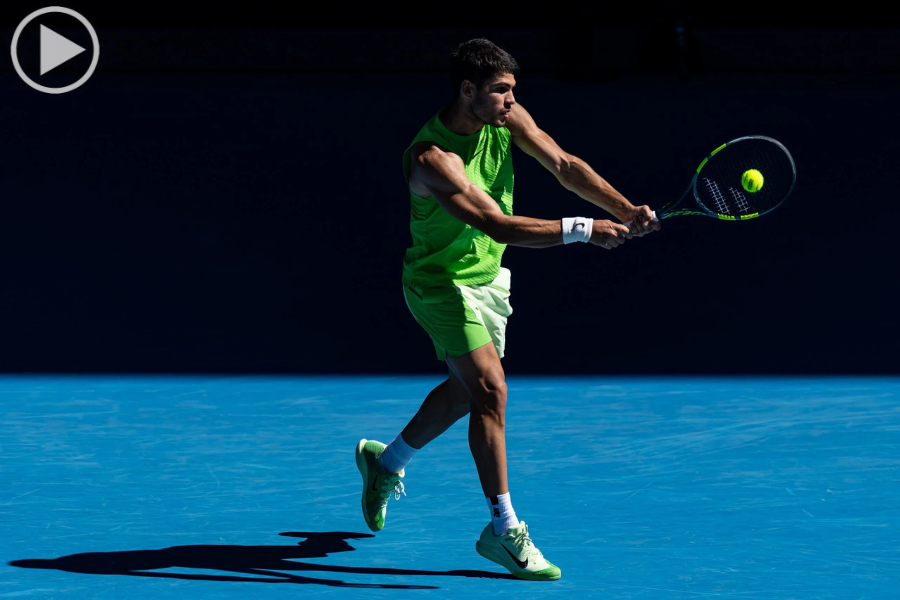
For two sets, Alcaraz looked untouchable. His forehand controlled rallies, his movement was explosive, and Zverev struggled to find answers from the baseline. Serving at 5-4 in the third set, the Spaniard stood two points from victory, having not dropped a set all tournament.
At that point, Alcaraz had been playing the kind of tennis that won him last year’s US Open and helped him evenly split the past eight Grand Slam titles with Jannik Sinner — a rivalry rapidly defining the current era.
The Turning Point
Everything changed moments later. After holding serve to move ahead 5-4 in the third set, Alcaraz began limping during the changeover and called for the physiotherapist. He rubbed the inside of his upper right thigh and received treatment, including massage to the same area, while also drinking pickle juice in an attempt to counter cramping.
Zverev reacted angrily, complaining to tournament officials and audibly describing the situation as “absolute bullst”, arguing that cramp was a conditioning issue rather than an injury and should not warrant a medical timeout. The atmosphere on Rod Laver Arena tightened instantly.
When play resumed, Alcaraz’s movement was visibly compromised. Zverev took advantage, forcing a tie-break and winning it, before levelling the match in another fourth-set tie-break as the contest passed the four-hour mark.
A Battle of Wills
Despite limited footwork, Alcaraz refused to retreat. He shortened points, struck boldly off both wings and leaned heavily on the crowd for energy. Even so, Zverev seized early control in the fifth set by breaking in the opening game, placing himself within touching distance of his first Australian Open final.
The German continued to serve efficiently, fending off break points and pushing Alcaraz deeper into physical discomfort. At 5-4, Zverev stepped up to serve for the match.
The Defining Moments
What followed was the match’s decisive swing. Alcaraz suddenly found greater freedom of movement and attacked relentlessly, breaking serve to level the set. He then held for 6-5, and with Zverev serving to stay in the contest, the Spaniard sensed his chance.
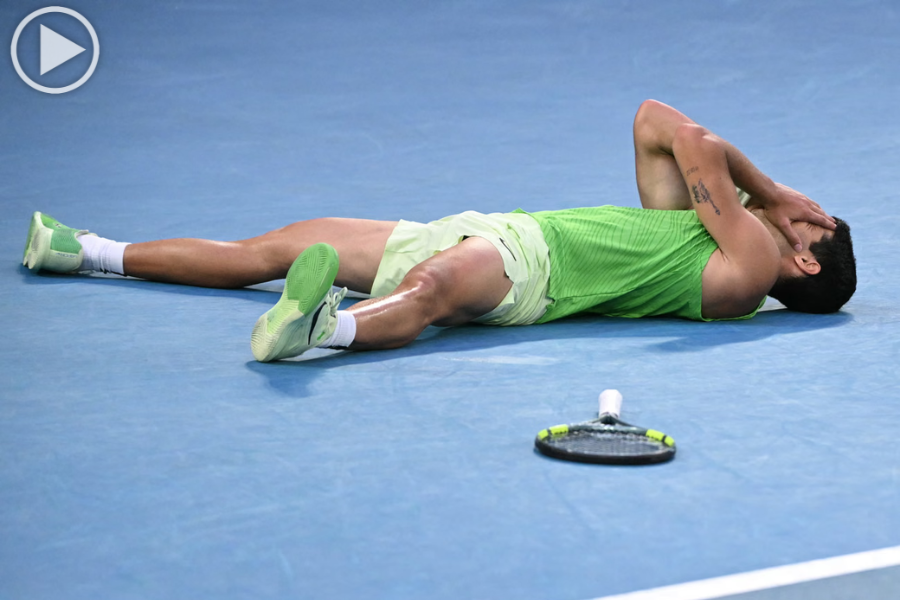
On match point, Zverev pushed a backhand long. Alcaraz collapsed onto the court, arms outstretched, in disbelief after completing one of the most demanding wins of his career.
“I always say that you have to believe in yourself,” Alcaraz said afterwards. “Physically, it was one of the most demanding matches I’ve ever played. But I had to put my heart into the match, and I fought until the last ball.”
History on the Line
The victory sends Alcaraz into his first Australian Open final and makes him the youngest man in the Open era to reach the final at all four Grand Slam tournaments. One more win would complete a career Grand Slam — a feat achieved by only a handful of players in tennis history.
Awaiting him will be either Jannik Sinner, the two-time defending champion, or Novak Djokovic, who is bidding for an unprecedented 25th Grand Slam singles title. Either matchup would represent a defining moment for the sport’s present and future.
Exhausted but unbroken, Alcaraz praised the Melbourne crowd for carrying him through the darkest stages of the contest. “Without them, I wouldn’t be here,” he said. “They pushed me back into the match.”
This was not merely a semi-final — it was a test of belief, resilience and courage. And in the longest, hardest hours, Carlos Alcaraz proved once again that his greatest weapon is not speed or power, but refusal to yield.